Dirt, Dust, and 600 Years of Silence: The Basement Dig That Rewrote a Midwest Town's Entire History
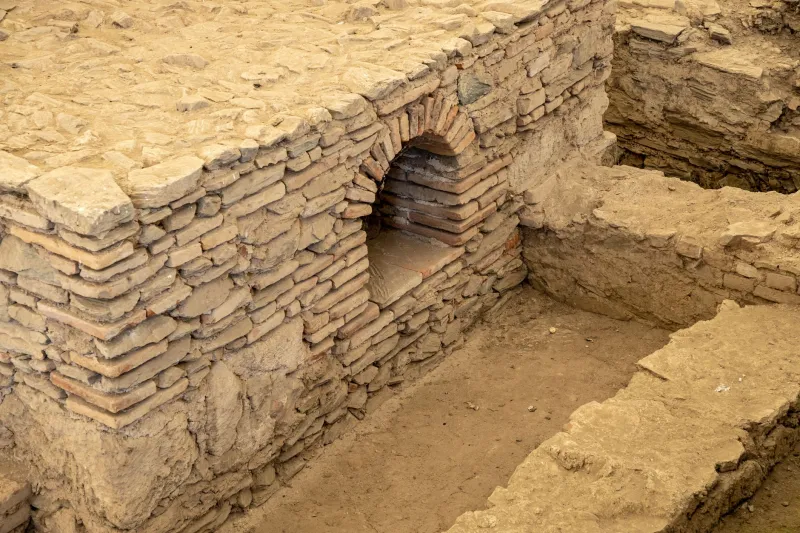
There's a version of this story where nothing happens. The contractor pours the concrete, the homeowner gets his extra bathroom, and six centuries of buried history stays exactly where it was — silent, compressed, forgotten. But that's not what happened.
What happened instead was a shovel hit something that didn't belong, and everything changed.
The Renovation That Wasn't Supposed to Be a Big Deal
In 2003, a homeowner in central Illinois — let's call him the most accidental archaeologist in state history — hired a crew to expand his basement. The house sat in a quiet residential neighborhood, the kind of place where the biggest surprise is usually a cracked pipe or a forgotten box of Christmas ornaments.
About three feet down, one of the workers struck something hard. Then another. Then a cluster of small, curved fragments that didn't look like rock and didn't look like anything that belonged in a century-old house foundation.
They were pottery shards. Old ones. And they weren't alone.
Over the next few hours, the crew pulled up fragments of fired clay, what appeared to be animal bones arranged in deliberate patterns, and the unmistakable outline of a post mold — the dark soil stain left behind when a wooden post rots away in place over hundreds of years. Someone had built something here. Someone had lived here. And nobody had written a single word about it.
Calling in the Experts
The homeowner, to his enormous credit, stopped the dig immediately and contacted the Illinois State Museum. Within days, archaeologists were on-site. What they found over the following weeks of careful excavation stunned even the veterans in the room.
The site contained the remnants of a Mississippian-culture village dating to roughly 1350–1450 CE — more than 600 years before anyone poured a single drop of concrete over it. The Mississippian culture was one of the most sophisticated pre-Columbian civilizations in North America, responsible for the massive earthen mounds at Cahokia near present-day St. Louis, intricate trade networks stretching from the Gulf Coast to the Great Lakes, and agricultural systems that fed thousands of people across the river valleys of the Midwest.
This particular village wasn't a major settlement. It was smaller — probably a satellite community, a farming outpost, or a seasonal gathering site. But it was intact in ways that made researchers genuinely emotional. Hearth remnants. Storage pit outlines. Ceramic vessels with decorative markings that matched regional styles from the late Mississippian period. And enough organic material to allow radiocarbon dating that placed human activity on that exact spot for at least three generations.
How an Entire Village Disappears
Here's the part of the story that's easy to overlook but impossible to shake once you think about it: this village didn't disappear because of violence, or flood, or fire. It disappeared because of time, and because of how history gets written.
When European settlers moved into the Illinois River Valley in the 18th and 19th centuries, they were working from maps and oral histories that reflected a world already dramatically reshaped by disease, displacement, and migration. Dozens of Indigenous communities had already moved, merged, or been erased in the century before formal American settlement began. The landscape those settlers walked onto looked empty. It wasn't. It had just been emptied.
By the time the land was surveyed, platted, and sold, there was no living community left to say: we were here, and this is where we buried our dead and stored our grain and built our walls. The land got a new name. Then a new owner. Then a foundation.
Archaeologists call this kind of site an "orphaned settlement" — a community that existed outside the range of written records and whose oral history was severed before it could be preserved. There are hundreds of them across the Midwest. Possibly thousands. Most of them are still underground.
What the Shards Actually Told Us
The pottery recovered from the Illinois basement turned out to be particularly significant. Several pieces bore incised geometric patterns consistent with a specific regional workshop tradition — meaning the clay wasn't just locally made, it was locally styled, part of an artistic tradition that connected this tiny satellite village to a much broader cultural network.
One fragment, less than four inches across, showed the partial outline of a hand motif — a symbol found repeatedly in Mississippian iconography and believed to carry ceremonial meaning. That fragment had been sitting three feet underground in a residential neighborhood for six centuries, waiting for someone to accidentally knock it loose with a rented excavation tool.
State archaeologists eventually documented 23 distinct features at the site — post molds, pits, hearths, and refuse deposits — before the excavation was complete. The homeowner, for his part, delayed his renovation by eight months and later told a local reporter that he considered it the most interesting thing that ever happened to him.
The Backyard as Archive
What makes this story remarkable isn't just the discovery itself. It's what the discovery implies about everything we haven't found yet.
The American Midwest sits on top of one of the most densely inhabited pre-Columbian landscapes on earth. The river valleys of Illinois, Indiana, Ohio, and Missouri were corridors of movement, agriculture, and settlement for thousands of years before European contact. And yet the vast majority of that history is invisible to us — not because it wasn't there, but because we built over it without looking.
Every year, construction projects across the country accidentally punch through layers of history that no academic survey ever flagged. Sometimes those discoveries get reported. Sometimes they get quietly reburied. And sometimes — like in a basement in central Illinois — they surface at exactly the right moment, in front of exactly the right person, and six hundred years of silence finally gets a little bit louder.
The extra bathroom, for what it's worth, eventually got built. Just a few feet to the left.