Rusting in the Desert: The Ghost Fleet That Never Touched an Ocean
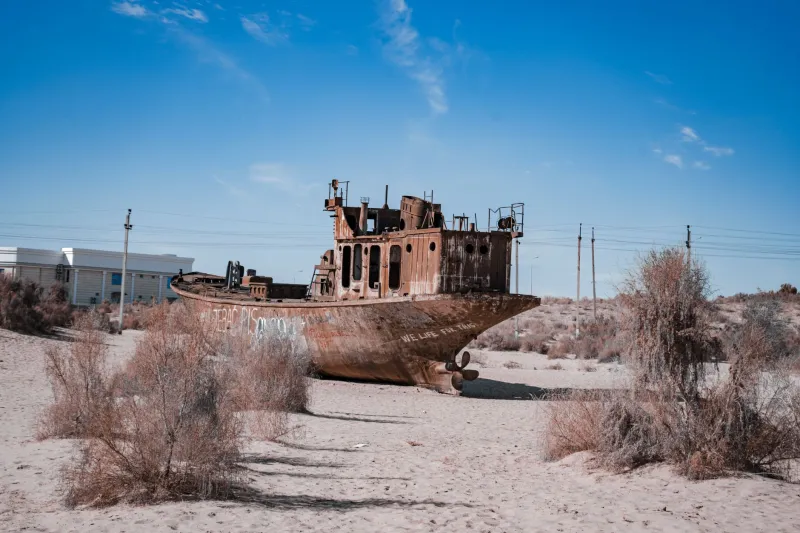
If you search for images of the Aral Sea ship graveyard, your brain does a small, involuntary reboot. The photos look like a film set — like someone placed scale models of freighters and fishing boats in the middle of a cracked, sandy wasteland as a piece of conceptual art. The horizon stretches out flat and dry in every direction. There is no water. There is no coastline. There is just desert, and sitting in it, enormous rusting ships.
This is not a film set. These ships are real. They sailed on a real sea. And the reason they're sitting in the desert is one of the most staggering environmental disasters in recorded history.
There Was a Sea Here
The Aral Sea was once the fourth-largest lake in the world. Straddling what is now Uzbekistan and Kazakhstan in Central Asia, it covered an area roughly the size of Ireland — about 26,000 square miles of water in the middle of a dry, landlocked region. It supported a fishing industry that employed tens of thousands of people. Towns dotted its shores. Boats crossed it daily.
By the 1950s, Soviet central planners had identified the region around the Aral as prime real estate for cotton production. Cotton needs enormous quantities of water. The two rivers that fed the Aral Sea — the Amu Darya and the Syr Darya — were the obvious source. Soviet engineers diverted them.
The decision was made at the highest levels of Soviet bureaucracy, with the kind of confidence that comes from believing you can simply overrule geography. The rivers were rerouted into an elaborate irrigation system that eventually stretched across millions of acres of farmland. Cotton production soared. The plan was, by the metrics the Soviet government chose to measure, a success.
The Aral Sea began to die.
The Disappearing Act
The process was slow enough that it didn't trigger immediate alarm — and fast enough that by the time the alarm should have been raised, it was far too late.
Through the 1960s and into the 1970s, the sea's water level dropped steadily. The shoreline retreated. Fishing villages that had once sat on the water's edge found themselves miles inland. The fishing industry — which had been pulling in roughly 40,000 tons of fish per year — collapsed entirely by the 1980s as the water became too shallow, too salty, and too toxic for fish to survive.
The boats didn't go anywhere. There was nowhere to take them.
As the water receded, vessels that had been docked in harbors or anchored offshore were simply left behind. Trawlers, cargo ships, smaller fishing boats — they sat in the mud as the shoreline pulled away from them, and then they sat in the sand as the mud dried out. The harbor town of Muynak, once a thriving port city in Uzbekistan, found itself landlocked. The sea that had defined it for generations was gone.
What the Desert Looks Like Now
The ships at Muynak — the most photographed of the Aral's ghost fleet — have become one of the most disorienting sights in Central Asia. A dozen or so large vessels remain visible, their hulls oxidized into deep shades of orange and brown, their structures slowly collapsing under decades of desert sun and wind. Some have been partially dismantled by scrap metal collectors. Some have tilted. Some have sunk slightly into the sand as though the earth is slowly swallowing them.
Around them, the former seabed stretches out as a salt flat — the Aralkum Desert, a new desert that didn't exist before the Soviet irrigation project. It is now one of the most heavily polluted deserts on the planet. The receding water left behind concentrated pesticides, fertilizers, and industrial chemicals that had accumulated in the sea over decades. When the wind blows, it carries toxic dust across the region, contributing to elevated rates of respiratory illness, cancer, and infant mortality in surrounding communities.
The ships are almost the least disturbing part of the story.
A Disaster Built on a Spreadsheet
What makes the Aral Sea collapse so difficult to fully absorb is that it wasn't an accident in the traditional sense. Nobody dropped something. Nobody made a calculation error. The Soviet planners knew the Aral Sea would shrink. Some internal documents suggest they knew it would shrink significantly. The decision was made anyway, on the grounds that agricultural productivity outweighed the value of the sea.
The human cost has been staggering. Hundreds of thousands of people lost livelihoods tied to the fishing industry. Entire communities were effectively stranded as the environment around them became uninhabitable. The regional public health crisis that followed the sea's disappearance continues to affect people today.
The southern basin of the Aral — the Uzbek side — is now essentially gone and is not expected to recover. The northern basin, in Kazakhstan, has seen partial recovery thanks to a dam project completed in 2005 that has allowed water levels to rise modestly. Fish have returned to some areas. But the southern sea, where the ghost ships rust in the sand, is almost certainly gone for good.
The Ships as a Kind of Monument
Visitors do make the trip to Muynak to see the ships. It's not an easy journey — the town is remote, the roads are rough, and the landscape is bleak in a way that's hard to prepare for. But people go.
There's something about the ships that resists easy explanation. They're not beautiful in any conventional sense. They're broken and toxic and sad. But they're also undeniably, almost violently real — physical proof that a sea existed here, that people worked on it, that an entire way of life was built around it and then lost.
No wave sank them. No storm drove them aground. The water just left, and they stayed.
In a world full of shipwrecks, these are the strangest ones: ships that were never wrecked at all.