He Woke Up From a Coma Speaking a Language Dead for 600 Years
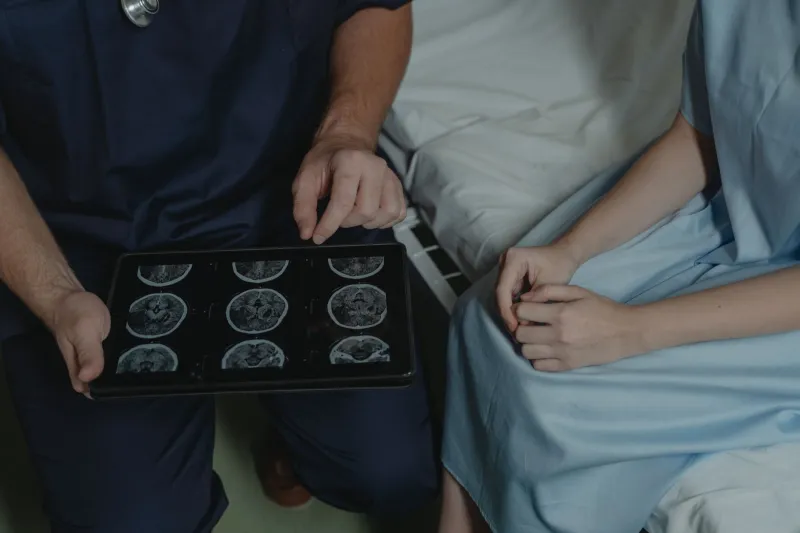
There's a moment in every medical mystery where the doctors stop writing in their notepads and just stare. For the neurologists treating Rhys Daniels — a 34-year-old piano teacher from Cardiff — that moment came about four days after he opened his eyes.
He was talking. That was good. He was responsive, oriented, and calm. Also good.
But nobody in the room understood a single word he was saying.
The Accident
In the spring of 2009, Daniels was cycling home from a late lesson when a delivery truck clipped him at an intersection. The impact threw him into a concrete divider. He arrived at University Hospital Wales with a traumatic brain injury — a subdural hematoma pressing against the left temporal lobe, the region of the brain most directly associated with language processing.
Surgeons relieved the pressure. He spent eleven days in a medically induced coma. When he came out of it, his vitals were stable, his motor function was largely intact, and he was speaking with fluid, unhurried confidence — in something that sounded vaguely like Welsh, but wasn't quite the Welsh anyone around him recognized.
His mother, a native Welsh speaker from Anglesey, sat beside his bed and shook her head. "I could catch a word here and there," she later told a BBC Wales reporter. "But it was like listening to someone speak English from Shakespeare's time. You know it's English. You just can't follow it."
A Language Nobody Speaks Anymore
It took three days and a frantic series of phone calls before someone tracked down Dr. Elin Meredith, a medieval Welsh linguist at Bangor University. She arrived at the hospital skeptical. She left visibly shaken.
What Daniels was speaking, she determined, was a form of Middle Welsh — the literary and spoken dialect used roughly between the 11th and 14th centuries. It bore the same relationship to modern Welsh that Chaucer's English bears to the language you're reading right now. Educated specialists can parse it. Nobody grows up speaking it.
Daniels had no formal training in medieval Welsh. He had no formal training in any Welsh beyond the conversational basics most Cardiff residents pick up passively. His school records showed he'd scraped through mandatory Welsh classes with middling grades and hadn't touched the subject since.
Yet here he was, constructing grammatically coherent sentences in a dialect that hadn't been anyone's native tongue since the Wars of the Roses.
What the Brain Does When It's Cornered
The neuroscience here is genuinely strange, and researchers have been arguing about cases like this for decades.
The dominant theory involves something called latent language acquisition — the idea that the brain absorbs far more linguistic data than conscious memory can access. Every medieval Welsh text digitized and uploaded to the internet, every documentary half-watched, every museum placard skimmed, every conversation overheard — the brain logs fragments of all of it. Normally, those fragments stay buried under the organized architecture of everyday language use.
But traumatic brain injury doesn't damage the brain evenly. It disrupts the pathways — the well-worn neural highways that connect thought to speech. When those highways are severed or rerouted, the brain sometimes falls back on secondary roads. Roads built from older, stranger materials.
Dr. Meredith's colleague, neuropsychologist Dr. Gareth Pryce, described it this way in a 2011 paper co-authored about the Daniels case: "The injury appears to have temporarily suppressed the dominant language network while leaving older, more fragmentary linguistic structures accessible. The patient wasn't retrieving a language he'd learned. He was retrieving pieces of one — and his brain was assembling them in real time."
The remarkable part isn't just that the fragments were there. It's that they were coherent.
The Slow Return
Over the following six weeks, Daniels' modern Welsh gradually reasserted itself. The medieval dialect didn't vanish dramatically — it faded, like a radio signal losing its tower. By the time he was discharged, he was speaking contemporary Welsh and English normally, with only occasional lapses into archaic phrasing that made his family laugh nervously.
He retained no memory of the medieval Welsh period. Shown transcripts of conversations from those first days, he described reading them as "looking at someone else's handwriting — technically mine, but completely unrecognizable."
His piano playing, notably, came back fully intact. The musical memory, stored in an entirely different neural region, had never gone anywhere.
Why This Case Still Matters
The Daniels case sits at the intersection of several things neuroscience still can't fully explain: the depth of passive language retention, the brain's fallback strategies under catastrophic stress, and the question of just how much information the human mind is silently hoarding at any given moment.
Foreign Accent Syndrome — a documented condition where brain injuries cause patients to speak their native language with a different accent — gets occasional media coverage. But cases involving genuinely distinct historical dialects are substantially rarer and substantially harder to explain away.
What makes this story so unsettling isn't the drama of the injury or the strangeness of the recovery. It's the quiet implication underneath both: somewhere in your brain, right now, there may be fragments of languages, dialects, and voices you've never consciously learned — waiting for some catastrophic rerouting to bring them briefly to the surface.
Most of us will never find out what's stored back there.
Rhys Daniels got a glimpse. He just couldn't tell anyone about it in a language they understood.