The Wrong Door That Nearly Sent an Innocent Man to Federal Prison
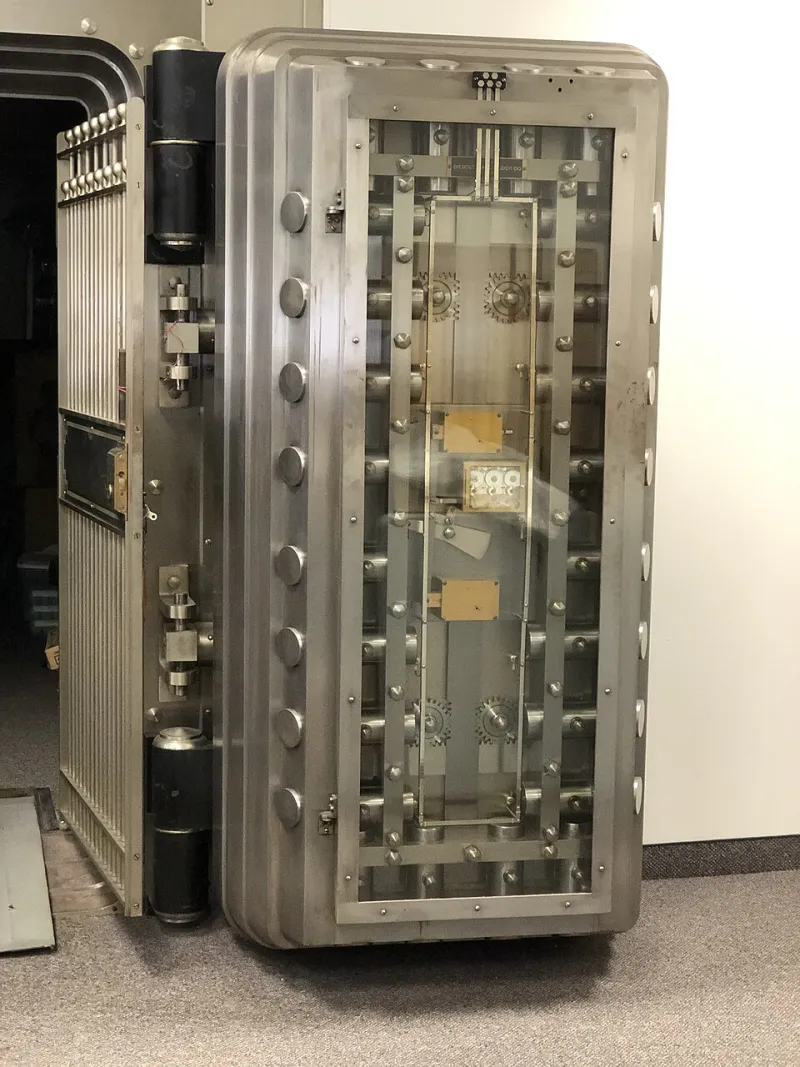
Photo: Mbrickn, CC BY-SA 4.0, via Wikimedia Commons
There is a version of this story where it ends in about thirty seconds. Man walks through wrong door, bank employee says "sir, this is the vault," man apologizes, everyone goes home. That is not what happened.
What actually happened in a small Ohio town in the spring of 1969 is one of the more remarkable examples of a completely innocent mistake metastasizing into a federal criminal case — and ultimately producing a legal ruling that changed how courts think about intent, trespassing, and the difference between a criminal and someone who is simply very bad at navigating unfamiliar buildings.
The Setup
The construction worker at the center of this story — identified in court documents by his initials, R.M., though local historical accounts give his first name as Raymond — had been hired as part of a crew doing renovation work on a commercial block in a small Ohio town about 40 miles southeast of Columbus. The crew was working on a building adjacent to a regional bank, and the two structures shared a back alley access point that had been temporarily opened to allow construction materials to pass through.
On a Tuesday morning in April, Raymond finished an early shift task and went looking for the break room that the general contractor had said was "through the back, second door on the left." The contractor had been describing a room inside the construction site office. Raymond, who had only started on the job two days earlier and was still getting his bearings, went through a door he believed matched that description.
It did not. The door he opened — which was unlocked due to a separate, unrelated maintenance issue that the bank had been meaning to address for two weeks — led directly into the bank's rear service corridor. Raymond walked down it, tried another door, and found himself standing inside the bank's main vault room during what happened to be an armored car cash transfer.
What the Bank Saw
From the perspective of everyone inside that vault, what they saw was a large man in a hard hat and work boots appearing suddenly in a secured area during a cash transfer. The armored car crew's protocol in that situation was unambiguous: they hit the alarm, they secured the cash, and they detained the individual until law enforcement arrived.
Raymond reportedly tried to explain immediately. He said he was looking for the break room, that he thought this was a different building, that he hadn't seen any signs. Nobody in that vault was in a position to take his word for it. Within four minutes, local police were on scene. Within the hour, because the incident had occurred during a federal cash transfer, the FBI had been notified.
The Investigation
The FBI's involvement transformed what might have been a local misunderstanding into something considerably more serious. Agents interviewed Raymond for several hours. They reviewed his background, his employment history, and — most damagingly — noted that he had no documentation proving he'd been hired for the construction job, because his paperwork was still being processed by the general contractor's office.
For a brief but genuinely frightening period, Raymond was treated as a suspect in a potential bank robbery conspiracy. The theory, as agents apparently explored it, was that his entry could have been a reconnaissance attempt — testing security response times ahead of a planned robbery. It sounds far-fetched in retrospect. At the time, it was enough to keep him under investigation for nearly three months.
His employer eventually produced the paperwork. Witnesses on the construction crew confirmed his presence and his habit of getting turned around on the job site. The contractor confirmed the vague break room directions he'd given. Slowly, the picture of a confused man rather than a calculating criminal came into focus.
The Courtroom
The federal prosecutor ultimately declined to pursue robbery or conspiracy charges — the evidence simply wasn't there. But Raymond was charged with unlawful entry of a federally insured financial institution, a charge that didn't require proving criminal intent under the statute as it was then written. The government's position was essentially: he was in the vault, the vault was off-limits, the law doesn't ask why.
Raymond's defense attorney argued that this interpretation was constitutionally dangerous. Criminalizing entry without any consideration of intent, he contended, meant that anyone who made a navigational mistake near a bank could theoretically face federal charges. The judge agreed that this reading deserved scrutiny.
The resulting ruling — handed down in late 1969 — held that prosecuting an individual for unlawful entry required at minimum a showing that the defendant had reason to know they were entering a restricted area. An unlocked, unmarked door in a building the defendant had legitimate reason to be near did not meet that threshold. The charge was dismissed.
The Ripple Effect
Legal scholars who have written about the case note that the ruling was narrow but meaningful. It was cited in subsequent Ohio cases involving trespassing and unlawful entry, particularly in situations where defendants claimed genuine confusion about boundaries or access points. It quietly reinforced a principle that sounds obvious but apparently needed spelling out: being somewhere you shouldn't be isn't a crime if you had no realistic way of knowing you shouldn't be there.
Raymond, for his part, reportedly finished out his construction contract and moved on. Whether he ever found the actual break room is not recorded.
The bank fixed the door.